
Today is June 30th.
Half the year is gone.
For some people, the first six months of 2026 have been incredible. New opportunities. New clarity. Better visibility. Stronger confidence. Real movement.
For others, the first half may have felt slow, heavy, confusing, or disappointing.
And for many of us working in diagnostics, laboratory science, market access, commercial life sciences, and health systems, the year has already carried a lot.
Funding pressures. Policy shifts. Pipeline delays. Career uncertainty. The everyday complexity of building impact in systems that are still evolving.
This is a good time to pause.
Not to judge yourself.
To understand yourself.
Because June 30th is more than the end of a month.
It is half-time.
And half-time is where you review the first half, adjust your strategy, and return with clearer eyes.
A half-time review is a clarity exercise
A mid-year review should not only be about targets, achievements, or missed goals.
It should help you answer one simple question:
What did the first six months teach me?
What worked?
What did not work?
What drained me?
What strengthened me?
What did I keep postponing?
What do I now know that I did not know on January 1st?
The goal is not to punish yourself for what did not happen.
The goal is to extract value from what did happen.
Even the difficult months carry information.
The delay taught you something.
The rejection taught you something.
The opportunity that came unexpectedly taught you something.
The thing that worked better than you expected also taught you something.
Nothing is wasted when you are willing to learn from it.
Start with what worked
Ask yourself honestly:
What actually moved the needle in the first half of the year?
Not what kept you busy.
Not what looked impressive.
Not what filled your calendar.
What created real movement?
Maybe you completed a course.
Maybe you finally updated your CV.
Maybe you started showing up on LinkedIn.
Maybe you joined a professional community.
Maybe you had a conversation that gave you clarity.
Maybe you started seeing your career beyond the bench.
Write it down.
Then ask yourself why it worked.
Was it consistency?
Preparation?
Support?
Courage?
Better positioning?
A clearer decision?
Whatever worked in the first half deserves your attention in the second half.
Protect it. Repeat it. Strengthen it.
Be honest about what did not work
Now ask the harder question:
What did not work?
Maybe you kept postponing the same application.
Maybe you said you wanted visibility but stayed silent.
Maybe you attended webinars but did not apply what you learned.
Maybe you wanted to transition into a new career path but never created a learning plan.
Maybe you stayed busy, but not with the things that could move you forward.
This is not about shame.
This is about truth.
If something did not serve you in the first half, you need to decide whether it deserves space in the second half.
Some habits need to stop.
Some commitments need to be reviewed.
Some distractions need to be removed.
Some goals need to be simplified.
A new month will not fix an old pattern unless you are honest about it.
Audit your energy
One of the most important half-time questions is this:
What am I still carrying that was never mine to carry?
Many professionals are not short of ambition.
They are exhausted.
They are doing too much manually.
Saying yes too often.
Carrying too many silent responsibilities.
Trying to grow without enough support.
Your time is a resource.
Your energy is a resource.
Your attention is a resource.
Protect them.
Ask yourself:
What drained me repeatedly?
What took too much time for too little value?
What can I delegate, automate, simplify, or drop?
What am I doing alone that I should be doing with support?
The second half of the year will require energy. Be careful where you spend it.

How to assess the last six months critically
Take the next 24 hours and write your answers down.
Start with these five questions:
- What worked well? List the habits, decisions, relationships, and actions that created progress.
- What did not work? Name the things that stalled, drained you, distracted you, or kept you in the same place.
- What did I avoid? The application. The conversation. The skill. The decision. The opportunity.
- Where did my time and energy go? Look at your calendar, your commitments, and your results. Did they match your priorities?
- What must be true by December 31st? Be specific. Write one outcome that matters enough to guide your next six months.
Do not keep it vague.
Do you want to apply for better roles?
Build visibility?
Complete a certification?
Move into commercial life sciences, quality, sales, regulatory affairs, project management, market access, or public health?
Speak more confidently about your work?
Grow beyond the bench?
Write it clearly.
A vague goal cannot guide your behavior.
If the first half was hard, you are informed
If the first six months did not go as planned, the year is not over.
You are not behind.
You are informed.
You now know what your current routine can support.
You know what you have been avoiding.
You know where you need help.
You know which skills are becoming urgent.
You know the kind of professional you no longer want to remain.
That information is valuable.
Use it.

Build your support system
Once you know what you want to be true by December 31st, find people who can help you stay aligned.
Find one mentor, coach, senior colleague, or role model whose experience can sharpen your thinking.
Then find two accountability partners.
People who will check in.
People who will challenge your excuses.
People who will remind you of what you said you wanted when your motivation starts dropping.
Accountability is infrastructure.
And if you are part of a community, do not only observe.
Participate.
Ask questions.
Share progress.
Support someone else.
Sometimes the help you need is already in the room, but you have to speak up.
The second half starts tomorrow
July is a doorway.
You do not need to fix everything at once.
You need to make better decisions with the information you now have.
Choose focus.
Choose clarity.
Choose support.
Choose consistency.
Choose the kind of growth that can be seen in your actions, not just your intentions.
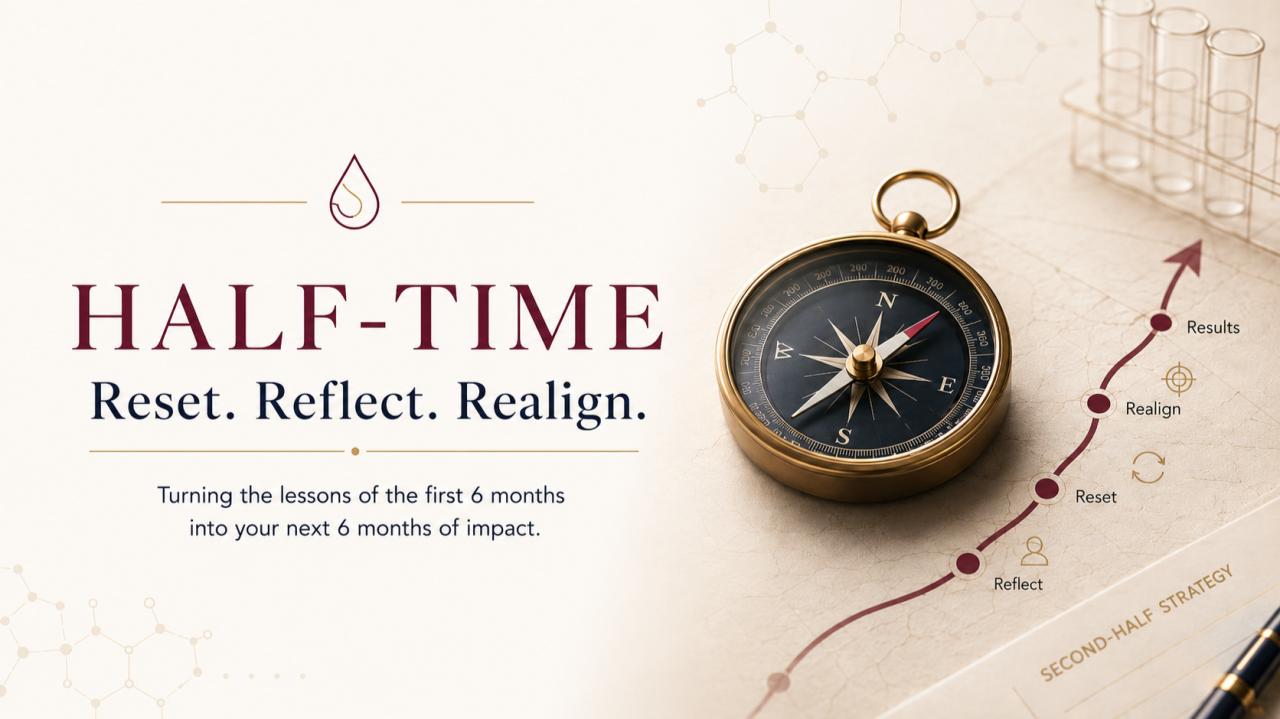
Half-time is here.
Reset.
Reflect.
Realign.
Then return with intention.
There is still time to turn insight into movement, movement into confidence, and confidence into visible progress.