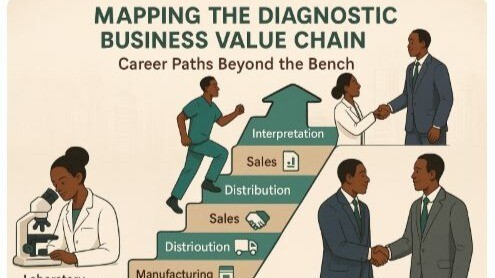

When laboratory professionals consider entrepreneurship, distribution businesses often come first to mind. While diagnostic distribution offers excellent opportunities (as we explored previously), it represents just one of many potential entrepreneurial paths.
The most innovative laboratory businesses often emerge from professionals who identify specific gaps in the diagnostic ecosystem and create solutions beyond traditional product sales.
The Entrepreneurial Landscape Beyond Distribution
Consider these laboratory-adjacent business opportunities:
- Mobile Testing Services: Bringing diagnostic access to underserved areas
- Specialized Laboratory Services: Offering niche testing not widely available
- Training and Education: Developing professional skills for laboratory staff
- Quality Management Services: Supporting laboratories in accreditation journeys
- Laboratory Design and Setup: Creating efficient, compliant facilities
- Digital Health Solutions: Developing technology for result delivery and interpretation
- Specimen Collection Networks: Building effective sample transportation systems
- Laboratory Staffing Services: Providing qualified personnel to facilities
Each model leverages your laboratory expertise while addressing critical gaps in the healthcare ecosystem.

Identifying Your Entrepreneurial Sweet Spot
The most successful laboratory entrepreneurs find business ideas at the intersection of:
1. Personal Expertise: Areas where you have deep knowledge and credibility
2. Market Gap: Unmet needs in the diagnostic ecosystem
3. Scalable Solution: Approaches that can grow beyond your personal capacity
4. Sustainable Model: Services that deliver ongoing value and revenue
The ideal business addresses problems you’ve personally experienced and understand deeply.
Case Study: Laboratory Quality Consulting
After helping his own laboratory achieve ISO accreditation, Michael, a friend of mine recognized that many facilities struggled with quality management implementation. Rather than pursuing traditional career advancement, he developed a consulting practice focused exclusively on preparing laboratories for accreditation.
Starting with a single client laboratory, he created systematic approaches for quality system development. Within three years, his company had served over 20 laboratories and expanded to include three additional consultants.
Key success factors:
- Leveraged specific expertise gained through personal experience
- Developed standardized methodology for consistent client results
- Created templates and tools that improved efficiency
- Built reputation through documented client successes
- Expanded services gradually as client base grew
Practical Steps to Laboratory Entrepreneurship
The journey from laboratory professional to entrepreneur involves:
1. Problem Identification: Recognize specific challenges in the diagnostic ecosystem
2. Solution Development: Create initial approaches to addressing these needs
3. Market Validation: Confirm that others value your proposed solution
4. Minimum Viable Offering: Develop the simplest version of your service
5. Pilot Implementation: Test your approach with early clients or customers
6. Refinement and Scaling: Improve your model based on real-world feedback
Many successful laboratory entrepreneurs begin as side hustles while maintaining employment, transitioning to full-time business operation as traction increases.
Essential Resources for Getting Started
Building a laboratory business requires:
- Knowledge Resources: Business fundamentals education (many available online)
- Mentorship: Guidance from others who have built healthcare businesses
- Network: Connections to potential clients, partners, and supporters
- Startup Capital: Initial funding (often modest for service-based businesses)
- Legal Structure: Appropriate business registration and compliance
The good news? Service-based laboratory businesses often require minimal upfront investment compared to traditional capital-intensive healthcare ventures.

Your Entrepreneurial Exploration Plan
If laboratory entrepreneurship interests you:
1. List three specific problems you’ve repeatedly encountered in the diagnostic ecosystem
2. For each problem, brainstorm potential business solutions
3. Research whether others are addressing these needs in your market
4. Identify the minimum resources needed to test your solution
5. Connect with other healthcare entrepreneurs for guidance
Remember: The most sustainable businesses solve problems you deeply understand. Your years of laboratory experience have likely revealed opportunities that non-laboratory entrepreneurs would never recognize.
If you are interested in going the entrepreneurship path but don’t know how to start. Join our community to sharpen your plans, we are called the benchtobusinessfellows. Fill this form to join-https://bit.ly/benchtobusinessfellows
What laboratory challenges have you observed that might represent business opportunities? Share your insights!